A Quiet Moment


Among the Bluebells:
A Quiet Moment with the Grey Squirrel
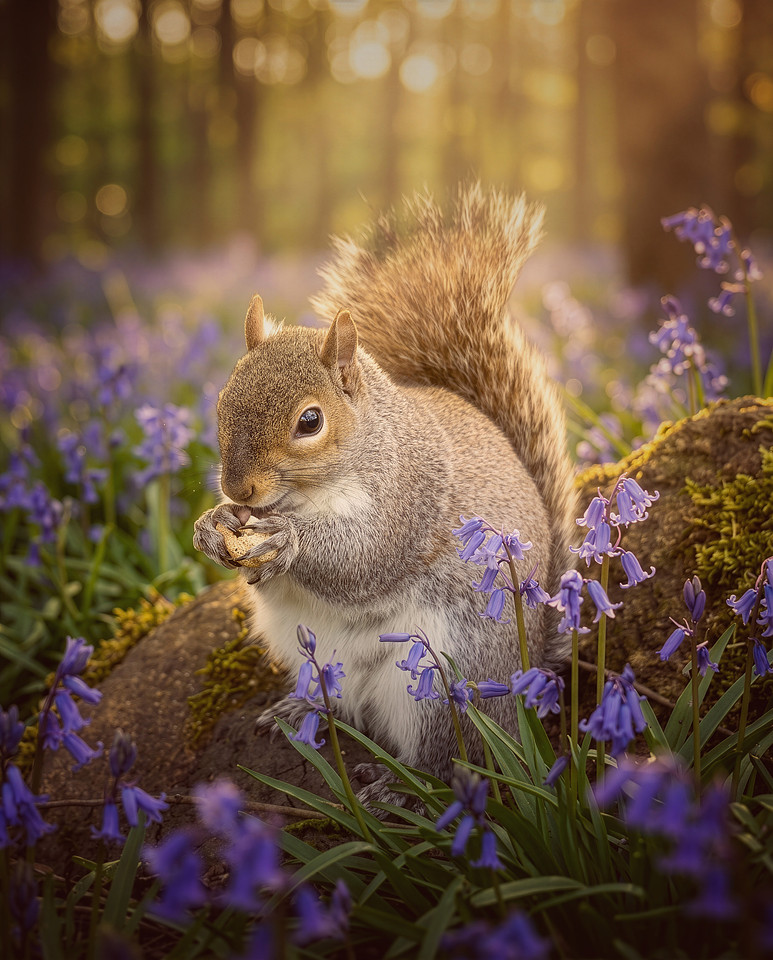
There are moments in wildlife photography when everything seems to fall perfectly into place: the light, the setting, the subject, and that brief instant of behaviour that gives an image its personality. This photograph of a grey squirrel surrounded by bluebells was one of those moments.
Bathed in warm, golden light, the squirrel sits comfortably among the flowers, holding a small piece of food delicately between its paws. Its attention appears completely fixed on its meal, seemingly unaware of the camera. That natural behaviour is what gives the photograph its charm. Rather than simply recording what a grey squirrel looks like, the image captures a small glimpse into its everyday world.
A Familiar Animal Seen Differently
Grey squirrels are so common across much of Britain that it can be easy to overlook them. We see them racing along branches, burying food beneath fallen leaves, crossing paths in parks and gardens, or sitting high in a tree watching the world below.
But familiarity does not make them any less fascinating.
Spend a little time observing a grey squirrel and you quickly begin to notice how expressive they can be. Their movements are fast and purposeful, yet when they stop to feed there is often a surprising delicacy in the way they use their front paws. Their bright eyes constantly scan their surroundings, while their large bushy tails seem almost to have a personality of their own.
In this image, the raised tail creates a beautiful natural backdrop behind the squirrel, helping to frame the subject while adding texture and warmth to the composition.
Nature Providing the Perfect Setting
The bluebells transform what could have been a simple wildlife portrait into something far more atmospheric.
Their rich purple and blue tones contrast beautifully with the soft greys and warm browns of the squirrel’s fur. Some flowers remain sharply recognisable around the animal, while others dissolve gently into the foreground and background, creating depth and giving the photograph an almost dreamlike quality.
Behind the squirrel, the woodland disappears into soft circles of golden light. This blurred background keeps attention firmly on the animal while still giving us a sense of the environment in which it was photographed.
It is one of the things I enjoy most about wildlife photography: sometimes the surroundings become almost as important as the animal itself.
Waiting for the Moment
Photographing wildlife is rarely about simply finding an animal and pressing the shutter.
Often, the real photography begins afterwards.
It means watching behaviour, anticipating movement and waiting for those few seconds when the subject moves into the right position. A turn of the head, a glance towards the camera or, as in this case, the simple act of holding food can completely change an image.
Patience allows those natural moments to happen.
With animals such as squirrels, movements can change incredibly quickly. One second they may be sitting perfectly still; the next they are racing across the woodland floor or disappearing up a nearby tree. Being ready for that fleeting moment is part of what makes photographing them so enjoyable.
The Importance of the Eyes
For me, one of the strongest features of this photograph is the squirrel’s eye.
In wildlife photography, the eyes often create the connection between the subject and the viewer. Even though this squirrel is concentrating on its food rather than looking directly into the camera, the eye remains bright and detailed.
That small highlight brings life to the photograph.
Combined with the fine detail of the fur, whiskers and paws, it gives the viewer the feeling of being remarkably close to the animal without disturbing it.
Finding Beauty in the Ordinary
Wildlife photography does not always require travelling to distant places or searching for rare species.
Sometimes the most rewarding photographs can come from animals we see almost every day.
The challenge is learning to see them differently.
Light, background, season and behaviour can transform a familiar subject into something special. The same squirrel photographed on a dull pavement might appear completely ordinary, but surrounded by woodland bluebells and illuminated by warm evening light, it becomes part of a much more beautiful story.
That is one of the reasons I continue to enjoy photographing wildlife. You never quite know when an ordinary encounter will suddenly become an extraordinary photograph.
A Small Moment in the Woodland
What I love most about this image is its sense of peace.
For just a few seconds, the squirrel appears completely settled in its surroundings, quietly eating among the bluebells while warm light filters through the trees behind it.
There is no drama and no spectacular action.
Instead, it is simply a small, intimate moment from the natural world — the kind of moment that might easily pass unnoticed.
And perhaps that is exactly what photography allows us to do: stop for a moment, look a little closer, and appreciate the beauty that was there all along.